
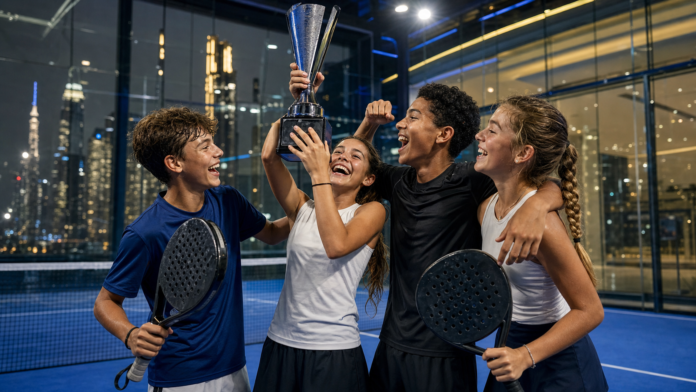

Dubai padel tournament results are putting the spotlight on young players after the third Dubai Open Padel Academies Tournament wrapped up with 29 youth teams competing across three age groups.
The event was organised by Dubai Sports Council in cooperation with the UAE Tennis and Padel Association and World Padel Academy. It was held at World Padel Academy in Dubai and focused on under-12, under-14 and under-16 players.
Who Took The Top Spots?
In the under-16 category, Kirill Gorokhov and Heerad Hemat claimed first place, while Sebastian Hardwick and Spencer Barnsley finished as runners-up.
Heerad Hemat then completed a second win in the under-14 category, teaming up with Yasser Kanaan to take the title ahead of Adam Hammoud and Arseniy Soloviev.
In the under-12 category, Matias Esquivel and Lev Molyboga finished first. Fares Ali and Gievano Lyon took the runner-up position.
Why The Tournament Matters
Padel has grown quickly across the UAE, with new courts, academies and social leagues helping the sport reach families as well as adult players. Youth tournaments are important because they turn that popularity into a proper development pathway.
This edition included 58 players from 11 sports academies across the UAE. That gives organisers a clearer view of talent levels and helps young players test themselves outside regular coaching sessions.
For young athletes, competition creates a different kind of learning. Players have to manage nerves, communicate with a partner, adapt to stronger opponents and recover after mistakes in real time.
Talent Scouts Were Watching
The tournament also worked as a talent-identification platform. Players were monitored and classified by technical level so that promising athletes can be supported as they move towards more competitive pathways.
Breakthrough players identified across the age groups included Maktoum Ahmed and Rashid Al Attar from NAS Sports Academy, Tommaso Gabbiadini and Leonardo Rocca from Robur Academy, and several other academy and school players in the under-14 and under-16 categories.
How It Fits Dubai Sports Strategy
The event connects with the Dubai Sports Sector Strategic Plan 2033, which aims to develop local talent and build a stronger sports ecosystem. Youth competitions give that strategy a practical base because they create match experience, rankings, coaching feedback and motivation.
They also help schools and academies understand where players need support. For a sport growing as quickly as padel, that structure can make the difference between a casual trend and a lasting competitive scene.
What Parents And Players Can Take From It
For parents, the tournament shows that youth padel in Dubai is becoming more organised. Children who enjoy the sport can now look beyond casual sessions and towards academy training, team events and age-group competitions.
It also gives families a clearer way to judge progress. A child may enjoy weekly training, but tournament play reveals match temperament, tactical awareness and where coaching should focus next.
Dubai Bliss readers tracking family sports can also read about the Dubai summer sailing camp for another youth activity option. Current Dubai sport updates are available through the Dubai Sports Council website.
The main win is bigger than the medals. Dubai’s padel pipeline now has more young players, more academy involvement and more reasons for families to take the sport seriously today.
FAQs
What was the Dubai Open Padel Academies Tournament?
It was a youth padel tournament organised with Dubai Sports Council, the UAE Tennis and Padel Association and World Padel Academy. The third edition featured under-12, under-14 and under-16 categories.
How many teams competed?
The tournament featured 29 youth teams with 58 players. They represented 11 sports academies from across the UAE.
Who won the under-16 category?
Kirill Gorokhov and Heerad Hemat won the under-16 category. Sebastian Hardwick and Spencer Barnsley finished as runners-up.
Why is youth padel growing in Dubai?
More courts, academies and competitions are giving young players a clear pathway. The sport is easy to start socially, but tournaments help serious players develop proper match experience.