
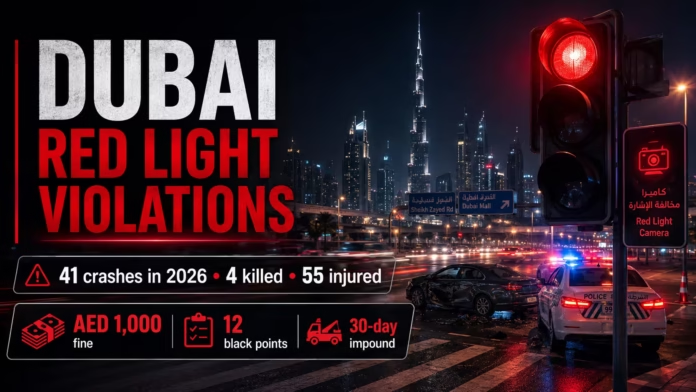

Dubai red light violations have caused 41 traffic accidents since the start of 2026, killing four people and injuring 55 others. Dubai Police has renewed its warning to motorists after linking many violations to distraction, poor judgement and risky intersection decisions.
The message is blunt because intersections leave little room for error. A driver who tries to beat a red or amber light can put pedestrians, passengers and other motorists in danger within seconds.
The 2026 Figures So Far
Dubai Police says red-light jumping has led to 41 crashes in Dubai this year. The same violations caused four deaths and 55 injuries, making the issue one of the clearest road-safety warnings for drivers in 2026.
The figures show why the offence carries serious penalties. A red signal is not only a traffic instruction. It protects vehicles moving across the junction, pedestrians using crossings and drivers who expect the intersection to be clear.
Fine, Black Points And Impoundment
Under UAE traffic rules, jumping a red light can bring a fine of AED 1,000, 12 black points and 30 days of vehicle impoundment. Those penalties are heavy because the risk is immediate and often severe.
The financial fine is only part of the consequence. Black points can affect a driver’s record, while impoundment can disrupt work, family plans and daily movement. More importantly, the human cost can be permanent.
Why Drivers Run Red Lights
Police linked the violations to distracted driving and misjudging speed or distance. Both problems are common at intersections, especially when drivers look at a phone, approach too fast or decide too late that they can still cross.
Amber lights can also create risky choices. Some drivers accelerate instead of slowing down, hoping to clear the junction before the signal changes. That decision can leave no time to react if another vehicle or pedestrian enters the crossing area.
What Motorists Should Do At Intersections
The safest habit is to reduce speed before reaching an intersection, especially when the signal has been green for a while. Drivers should keep both hands ready, scan the crossing area and avoid last-second acceleration.
If the light turns amber and stopping is safe, stop. If traffic ahead is slow, do not enter the junction unless there is enough space to clear it. Blocking or rushing through intersections increases risk for everyone around the vehicle.
Motorists can check official public-safety services through the Dubai Police website. Dubai Bliss readers can also read the recent Dubai road safety campaign guide, which explains related warnings on swerving, tailgating and distraction.
Why This Warning Matters Now
Dubai roads are fast, busy and heavily used by commuters, delivery riders, taxis, buses and visitors. Intersections are the points where different traffic flows meet, so one bad decision can affect several road users at once.
The warning also arrives while Dubai continues to push wider road-safety campaigns. Those campaigns are useful, but they only work if individual drivers change small habits before a crash happens.
A Practical Rule For Drivers
Treat every intersection as a decision point, not a place to gamble. If the signal is changing, slow down. If visibility is poor, slow down. If another driver is pressuring from behind, keep control and choose the safer option.
A few seconds saved at a traffic light are never worth a fine, black points, impoundment or a crash. The 2026 numbers make that clear.
For residents and visitors, the simplest advice remains the most useful: stay off the phone, approach signals calmly and never turn amber into a race.
FAQs
How many crashes did Dubai red light violations cause in 2026?
Dubai Police says red-light violations caused 41 traffic accidents since the start of 2026. Those crashes killed four people and injured 55 others.
What is the fine for jumping a red light in Dubai?
The penalty can include an AED 1,000 fine, 12 black points and 30 days of vehicle impoundment under UAE traffic rules.
Why do drivers run red lights?
Police linked many cases to distracted driving and misjudging speed or distance. Last-second decisions at amber lights also increase risk at intersections.
What should drivers do when approaching an amber light?
Drivers should slow down and stop if it is safe to do so. Accelerating to beat the signal can create serious danger for crossing traffic and pedestrians.